🌳
F-Gas / Refrigerant Phase-Out Strategy for 528
Roadmap to 2040
1. Strategic Objective
528 commits to eliminating reliance on high-Global Warming Potential (GWP) fluorinated refrigerants
(F-gases) across all facilities and operations by 2040, in advance of full phase-out requirements
anticipated in many jurisdictions (including the EU).
This supports climate mitigation goals, strengthens operational resilience, and aligns with emerging
regulatory trends and stakeholder expectations.
528 will:
• Systematically phase down F-gases in existing and new equipment.
• Switch to low-GWP or natural refrigerant technologies where safe, viable, and cost-effective.
• Maintain compliant maintenance, leak prevention and reporting practices.
• Integrate refrigerant-related environmental performance into sustainability reporting.
This strategy supports compliance with the EU F-Gas Regulation and ISO 14001 environmental
management objectives.
2. Regulatory Context & Key Trends
EU F-Gas Regulation
• The EU’s F-Gas Regulation (EU 2024/573) provides a phasedown of hydrofluorocarbons (HFCs) and
anticipates a complete phase-out by 2050, enforcing progressively tighter quotas and bans on high-
GWP refrigerants.
• New equipment bans and GWP limits are staged over the coming decade (e.g., prohibitions for
various product categories starting as early as 2025 and extending through the 2030s).
Global Agreements
• The Kigali Amendment to the Montreal Protocol also mandates significant cuts in HFC use globally,
reinforcing the need for corporate refrigerant transition planning beyond EU borders.
3. Key Strategic Pillars
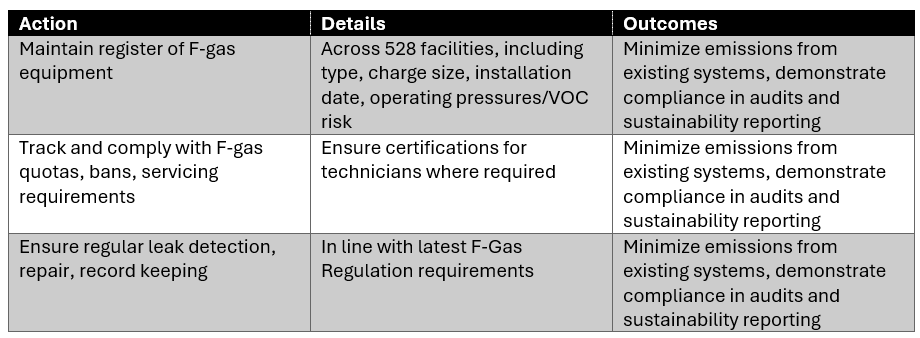
3.1 Regulatory Compliance & Monitoring
3.2 Phased Technical Transition Plan
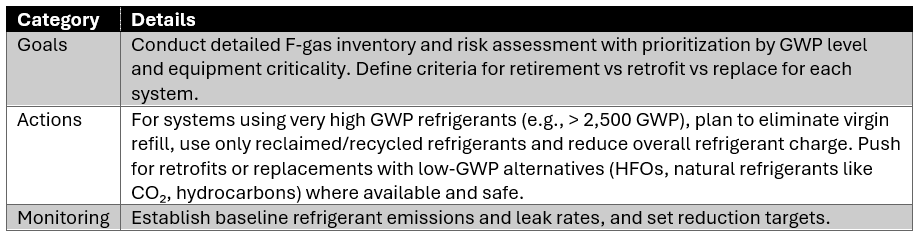
Phase 1 — Immediate (2026−2028): Assessment & Short-Term Actions
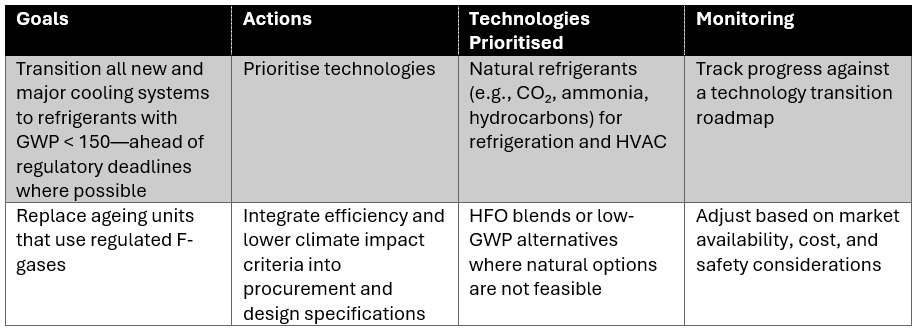
Phase 2 — Mid-Term (2029−2035): Accelerated
Uptake of Low/No-GWP Technologies
Phase 3 — Long-Term (2036−2040): Final Phase-Out
& Performance Optimisation

4. Measurement, Reporting & Integration
4.1 Performance Indicators
528 will track and report:
• Annual refrigerant usage by type and GWP.
• Leak rate (%) reductions.
• Equipment turnover to low-GWP alternatives.
• Residual emissions in CO₂e.
These indicators support ISO 14001 monitoring and CSRD/ESRS disclosures and provide evidence for
key performance indicators relating to operational environmental management.
4.2 Sustainability Reporting
• Disclose refrigerant transition performance in annual sustainability reports and in alignment with
international disclosures and climate reporting requirements.
5. Governance & Review
• The Environmental Steering Committee shall own implementation oversight, review progress
annually, and update the strategy to reflect regulatory developments and technology advancements.
• Articles of the F-Gas Regulation evolve, this strategy must be reviewed as part of the annual
sustainability management review.
6. Risk & Opportunity Considerations

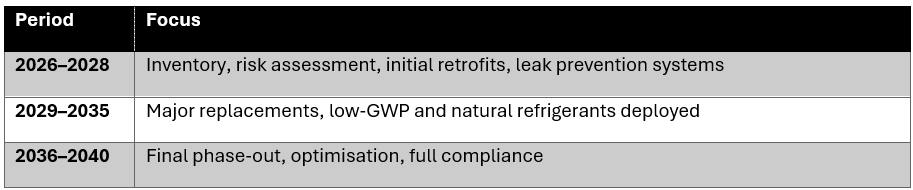
7. Timeline Summary